Can you introduce yourself?
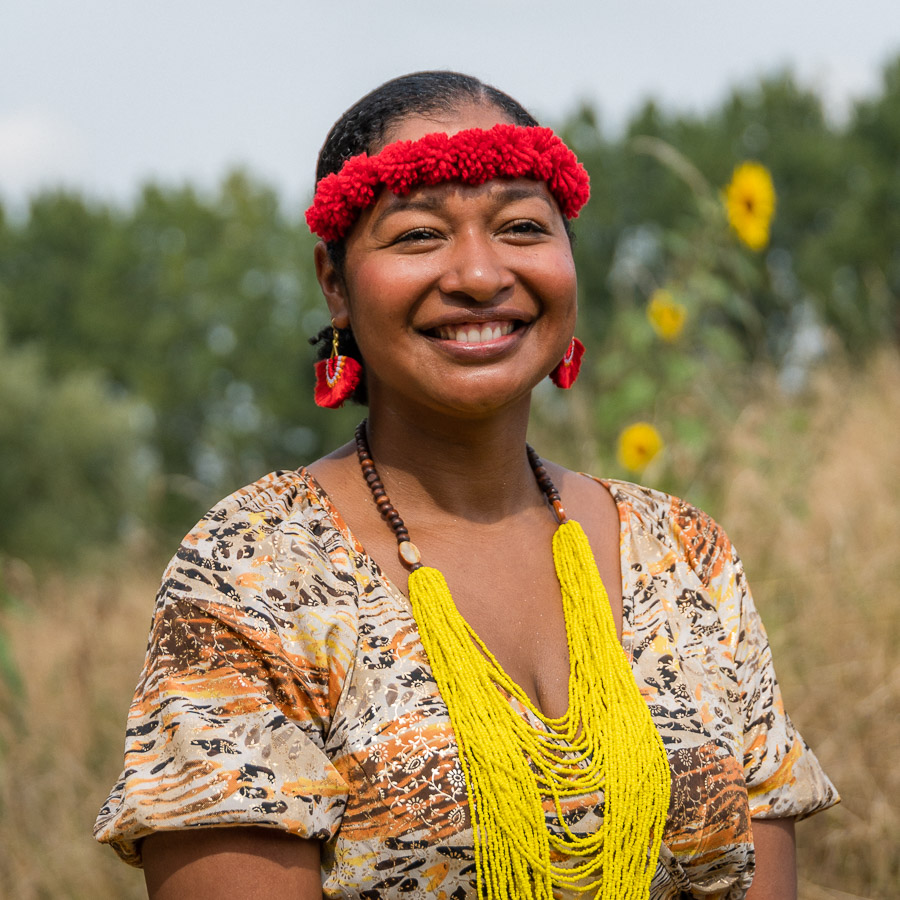
My name is Sherlien Sanches with an ‘s’. It sounds Spanish but it is Surinamese. People can understand how I got my last name through colonialism. I am now 43 years old, born in Suriname. My umbilical cord is also buried there. Then I came to the Netherlands when I was eight months old.
Here I put my feet on the ground and here my roots go into the ground. Here they get watered. Here is where I will settle. My mother, Reline, is a very proud Karinya Indigenous. And my father, John, is an Afro Surinamese man. I was raised with my mother’s culture. We Karinya live in the North of Suriname. Together with the Lokono (Arowaks is the colonial term) we are the two largest groups of Indigenous people in Suriname. My village there is called Akarani which gets its name from a fruit that you can eat in Suriname that grows in the region.
Where can you dream?

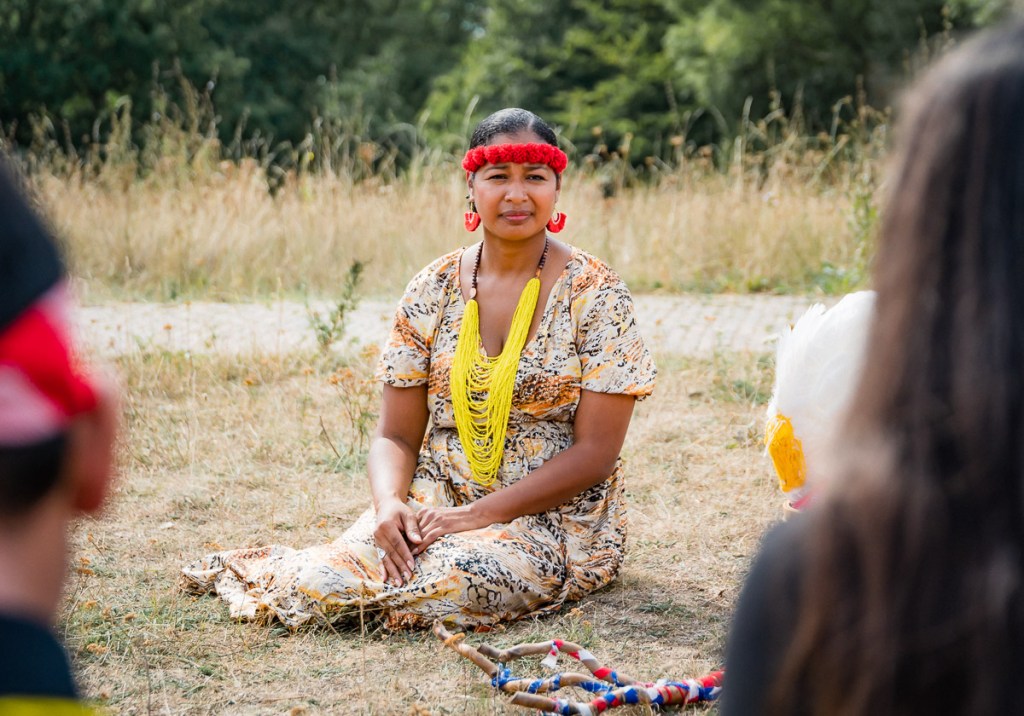
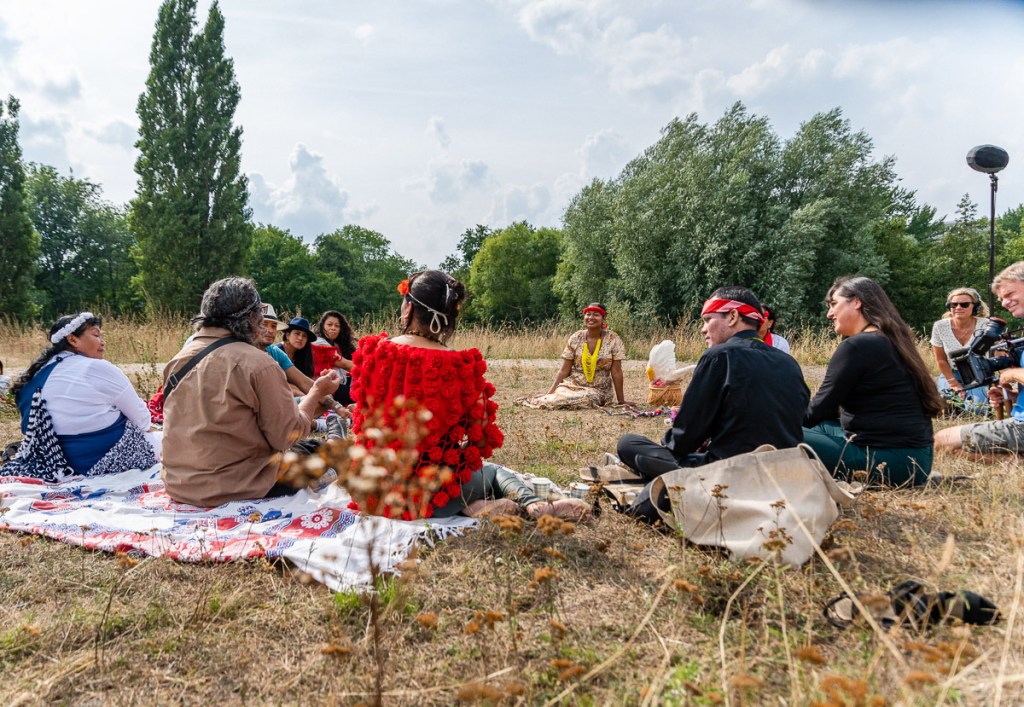
I dream daily and also try to write them down and analyze pevious dreams. If my energy is right, the more beautiful my dream is. My Indigenous dream is communal: to have our own place. I’m working on that now. The portrait was taken at an Indigenous gathering in the park near my house in Amsterdam Noord.

What is your Indigenous dream?
My dream has been for a very long time that we Indigenous communities have our own Indigenous knowledge center. Not a culture house – a knowledge center. A knowledge center is broader than just culture. My point is that now Indigenous cultures have no power over their own culture. That it is constantly being stolen and appropriated. There is no foothold where we can safeguard our culture, work and monitor it and pass it on when we want to and HOW we want to pass it on. There is no house. There is no center. That’s my dream, let’s start with that. Now I bring people together to realize this dream together. When I first started with Indigenous projects, about ten to fifteen years ago, I found it very hard to fathom that we didn’t have a fixed space where we could come together and organize. I miss stability. Why don’t we have space? I always compare it with religions. Think of the Christians who have the churches where they can gather, Muslims have the mosque and there are temples. They say the Natives have ‘nature’:’Don’t you have the outdoors?” But we don’t have the outdoors at all. If only we could steward more land; to be the guardians of the land. We are often denied that. And two, it’s important for us to come together somewhere for the recovery of our cultures. So much needs to be done. People do a lot in their own way, but we don’t have a communal space and we can’t be found by those who also look for Indigenous community. That struck me a long time ago: Why are we not supported? Why are there no subsidies?
Colonization has something to do with it. And the relationship with the nation-state.
We have lost a lot. But not the drive to be who we are. First of all, the language; this is very painful. We lose the language. The younger generation is now the key to change this. That is also linked to my dream: the knowledge center. We can work on language recovery there. Because language is identity. That makes who you are. Colonialism meant for Indigenous people that they had to hand over their culture, their faith. Often Roman Catholicism was imposed. I too was baptized. We were told that our language was not the language of success. “You have to speak Dutch”. With Dutch you will grow and develop. That was already forced on my mother and the generation before. When I come to the village now… the children no longer inherit the language. What I also find very painful is that the Indigenous thread of spirituality is disappearing. By that I mean; here in the Netherlands if you hold a piece of wood it means nothing to many. But in the forest my grandmother when you hold a piece of wood there is always a story. It’s not just wood. It is a bit of contact with nature that most Indigenous people have from their culture. Like our language, our spirituality has been demonized by colonialism. They say: “It is not right what you are doing with the spirit world. It’s devilish.” As a result, you see divisions in Indigenous families that are also falling apart. Because one person is involved in spirituality and worships the tree while a brother or sister says: “You shouldn’t be concerned with that. That is not the path for Jesus.” The pain of losing their spirituality is related to the young people who now think they have nothing and think they are worth nothing.
Injustice. That’s what I feel. And it is precisely the injustice that gives me the passion to say: “We are going to do this”
How do you handle losses?
When I was very young I still had issues being Indigenous. I found out I was Indigenous when I was in primary school and we had the ‘Suriname-theme’ at school here. And then I learned that there was an Afro Surinamese, Hindustani, Chinese, Javanese Surinamese. And then they asked me what kind of Surinamese I am. I shrugged my shoulders. I do not know. Then I went home and said: “Mom, what kind of Surinamese am I?”. Then my mother said: I am a Karinya Indian, you know that, don’t you?” And then I went to school and said I’m Indian. And then it came. “Oh-oh-oh-oh” she imitated like screams in cowboy movies and said “you have the feathers”. That horrible colonial stereotype hits you. And then I thought “Hey, this is not how we are at home?”. At home it was very normal to live with the spiritual world. When someone dies. Then we light a candle and put an egg out. This is normal to us. You also worship your spirit world. But at school I was laughed at again: “Haha, she believes in ghosts”. That!
Again and again in the conversations the belittling begins with the moment of going to school. The prohibition of one’s own language and the erasing of our histories.
Yes! And that Indigenous people have become such a fairytale character that we only appear as the ones being hunted by the cowboys: the ‘savages’ or ‘primatives’. Not nice. But I was always very proud. Even though people kept asking me, “Why is your mom’s hair straight?” Then I thought: “Yes, she is a Native so her hair is straight”. What’s wrong with me then? My father is Afro-Surinamese so I have frizzy hair. But my mother has straight hair. But I had to constantly explain that. I found that so painful. Not being allowed to simply be. In my teens I was also very furious at society. Then I got to know films like Shaka Zulu and Kunta Kinte, which come from the afro community and are about the slavery history. And then you think; what an injustice! And you see the Indigenous beings being exterminated. What an injustice. That injustice felt so bitter in my teenage years. Society is so perverse; such an ugly world and everyone is unfair. And again my mother: :Never give up. You decide how you propagate your culture. What has happened has already happened. What are you going to do with it now?” And now I’m in a field with all Indigenous people with related struggles. We have actually been fighting for the right to exist for 530 years. For the right of recognition; in order to exist. How is this possible?
In Karinya and Lokono villages they go to school until eighth grade. After that they have nothing. And then the question is: what should we do now? We have to make money because these days you have to have money for everything. Or you should go hunting. This is still being done, but on a small scale. Young people see the perspective of the city and they want the laptop, the sneakers, a smartphone. And then they get even more into a slump and think: We have nothing at all. But then! Then someone comes from the Netherlands. A student. He goes to a village and then asks some nephews: take me into the woods. Cousins do that and explain their environment; this is this and that is that. The student goes back to the Netherlands and gets a PhD. But our people lose the knowledge they have about the forest and its powers… that it is just as important as scientific knowledge. They look up to western universities. But they are not aware. What they have lost is self-esteem.
What about health? Lost health.
Alcohol is a big problem. It really is a health problem. There is such a feeling of: “what kind of life do I have? I have nothing. The government doesn’t care about me. They keep taking land and we miss our fundamental rights. I can’t go to town because I have no money. I am going to drink.”
And pollution and heavy metals and mercury and pollution of rivers…
That’s right. There are gold miners who use mercury in the water to make the gold float to the top. The fish eat the mercury, the people the fish. I was in Stockholm at the water conference two years ago. Here I heard that the mercury pollution also extends beyond Suriname into Peru and that there are now studies on the impact on mental health. Testing is being done on Indigenous people who experience the impact. The impact of mercury can literally wreck your intelligence and mental state. And heavy metals stay in your system for life. It’s terrible. Jupta Ituwaki, Indigenous local development worker and politician, is doing good work and breeding fish herself. We don’t know how healthy it is. But it is safer to be able to continue to eat for the community. Because the fish in the river can now make you sick.
How do we heal relationships with the Earth and each other?
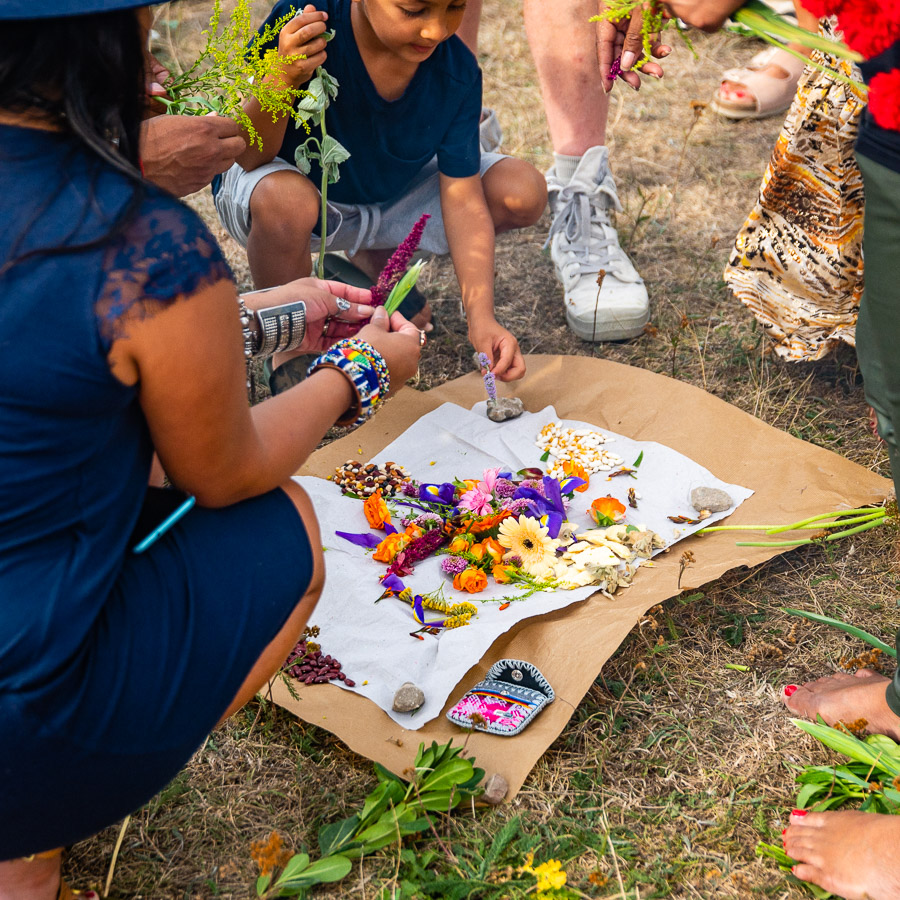
It’s a slow process. But it certainly can. Survival is our passion. They thought: we exterminate these people. Biggest genocide ever. They buried us but we are seeds and we’re about to pop out. I feel the energy; the power. Healing is needed! Our spirituality is a common thread among Indigenous people and this whole energy field that needs to be healed. In our own place we can work on healing.
With ceremony, healing and our ancestors. Because that has been clouded, scattered, polluted for so many years, there are a lot of hibbies hanging over us. Just see that many Indigenous people cannot work together. On a spiritual level it is bruya. We have to flow together again first. Ceremony is very important. I believe that the ancestors really help us make amends.
Photography: Mia Tengco
Artistic director/text editor: Chihiro Geuzebroek
 INDIGENOUS DREAMS
Leave a comment