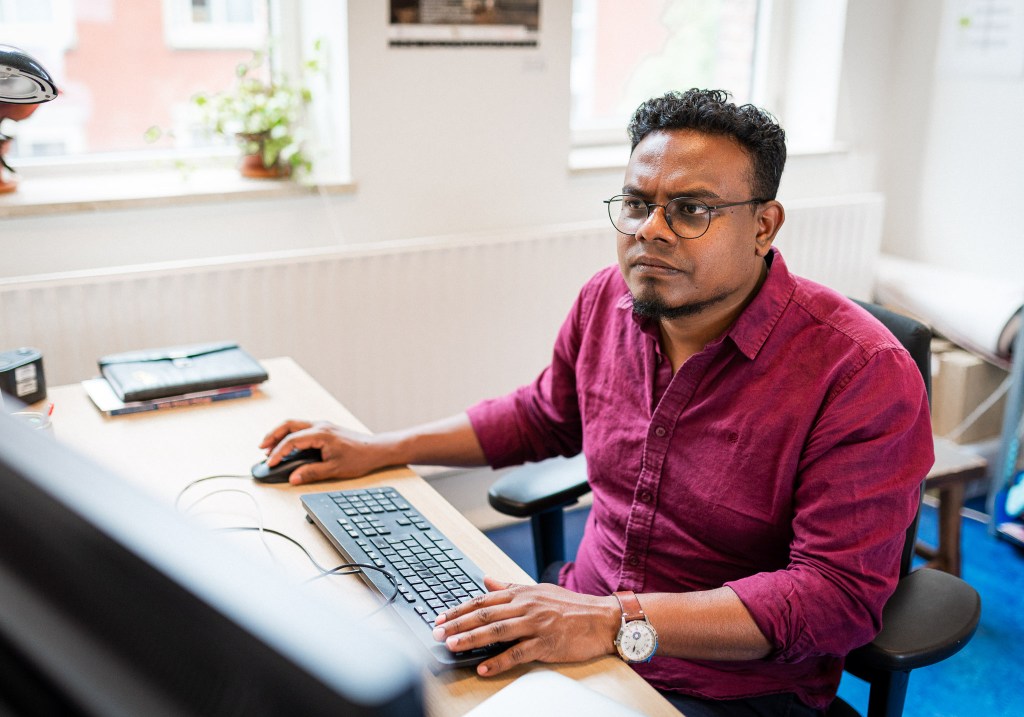
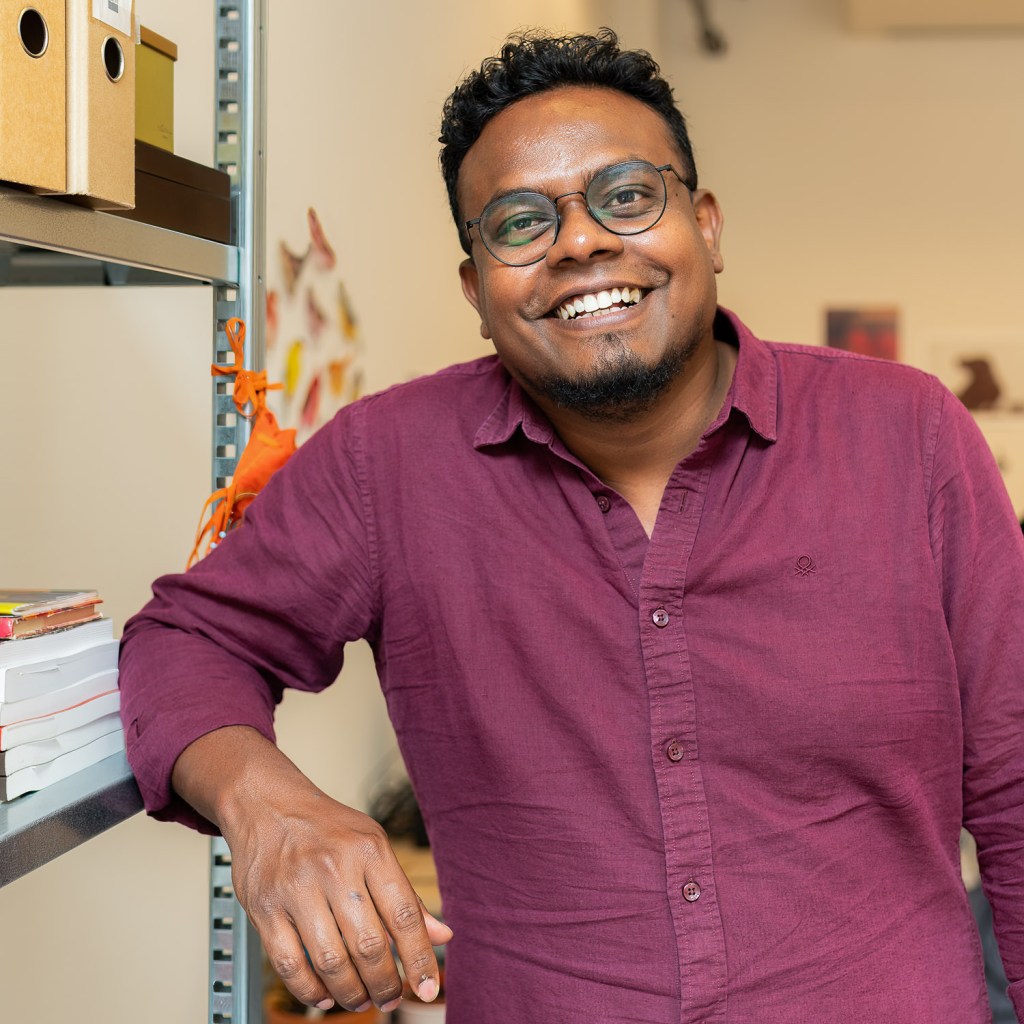
Can you introduce yourself?
I am Richard Toppo. I come from India from an Adivasi community called Oraon. My mother tongue is Kudukh, we are known as Kudukh people. I come from the eastern state of Jharkhand in India, from the Chota Nagpur Plateau. Regarding Oraon people, or Adivasis in general, there are barely any written accounts.
What we have come to know about our past is through oral narration, oral traditions and songs. Coming to the Netherlands was entirely for the purpose of doing my PhD. I had applied for a scholarship that I saw advertised on facebook. I got an interview call. The offer actually came in my I just so happened to fortunately check my spam on that particular day. I saw the offer and I thought: Ok, it is time to go to the Netherlands. I had never been here before.
Only after I came here did I find out that some of my former colleagues and friends are working in Leiden University. They came to my rescue big time actually. In 2016 India was going through this entire phase of demonetization. So what the government had done was declare that the currency we had previously was no longer valid. They issued a new currency. And to get hold of the new currency you had to stand in long cues for literally 8 to 10 hours. I didn’t have the time to do that. And of course the ATM cards were not working because there was a certain limitation. So I came here without having any cash. The money was in my bank account. I thought that when I came here I could swipe my card and access the money. That was what the bank authorities had told me. But the card did not work. So I was stranded at the airport for a couple of hours. I didn’t have any money even to come to The Hague. What should I do? So I just posted something on facebook and thankfully one of my friends happened to be an assistant professor in Leiden. He contacted me asking: What are you doing here? He thankfully came to my rescue.
I heard about that happening in India. That is outrageous. So I wonder where you can dream your Indigenous dream?
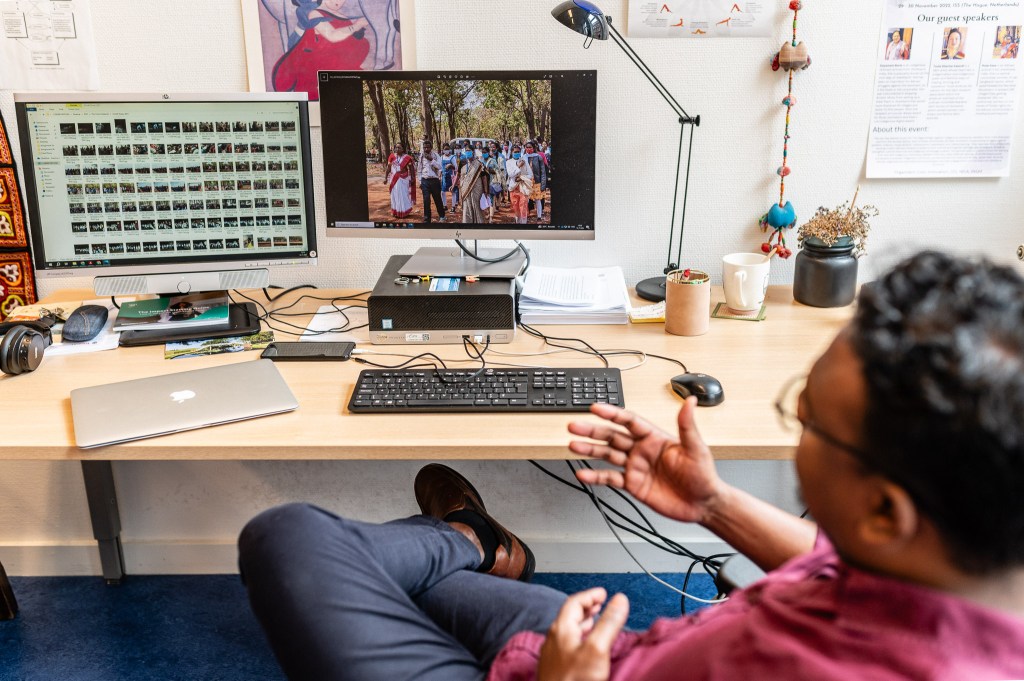
Everywhere actually. I dream of my people to be free. For now, I dream of it in this space, in my office at ISS university where I get to write about it, think about it, and interact. Herein, I write my thesis on Countering Hegemony, where I am looking into identity creation and Adivasi social movements. So, in this space, I get to dream the conversations I have had back at home, where I get to be with the dream; work through the politics and the relations of it and do something about it. I carry this dream everywhere.
So I know India has a different context for indigeneity than the so called Americas. So I would like to take some extra space to understand the name Adivasi. Can you share a bit more about your context of Indigeneity?
In popular discourse, the term Adivasi is generally used to refer to the indigenous people in India. However, tracing back the roots, Adivasi is a self declared word that had its origin in the 1920’s and 30’s. Before that, in Jharkhand, of course we had these communities, but no one called them Indigenous communities. Indigenous is a much more recent terminology. Before that the communities existed only as Oraon, Mundas etc. One of the most prominent Adivasi groups in Jharkhand, there are 32 Adivasi groups in this state, is Munda. They are considered to be one of the oldest communities. When we talk about Oraon we can derive some similarities with the Dravidian communities (from the Southern part of India). When Oraon shifted to this particular part (maybe in the 14th or 15th century) they were happily welcomed. There is a popular narrative that Mundas were being gracious enough to accommodate the Oraon. There was coexistence between the two communities and you won’t hear about conflicts between the two communities. Then came the colonial times. Before, people had their own sovereign spaces. When the colonial rulers came they actually singularized the entire system. Saying this is the structure that everyone has to follow. To put it in simplistic terms, this led to non-Adivasis, both local and foreign, trying to control and govern these communities, exploiting and oppressing them. Such instances brought people together to claim their identity as Adivasis, i.e., original residents, who fought for self-governance against the non-Adivasi singular governance system.
Monocultures and monorule.
Exactly. And who were the British listening to when this entire thing was happening. They were mostly listening to non-Adivasi, upper castes to understand who these communities were. The initial interactions between the British and the Adivasis was a very brutal confrontation where you have the Kol and Santal revolts and rebellions happening. Many Adivasi communities came together at times of revolt, so it wasn’t just one community fighting against the British and local Indian feudal landlords. They put out consistent demands. The non-Adivasi local Zamindas i.e., feudal lords, were very instrumental in oppressing.
They had more experience in ruling those lands. They knew how to be…
They knew how to be exploitative and oppressive. So if you look into the colonial records, the Adivasi were much more agitated by the local feudal lords. And then they went to the British to plead to them: Listen to us. But of course the British were going to listen to the other party. And this led to brutal confrontations. This was also the time, sometime in 1830’s and 1840’s, after a few revolts in Jharkhand, when the British designed different rules in some of these spaces. In India, we have two different setups where the Indigenous people in specified areas are governed and administered differently.
Is there some kind of treaty or is it some other set up?
If you call it a treaty it would mean that the other entity is a sovereign entity. India could not afford that. I don’t think the government is ever going to say that these are sovereign entities with a treaty.
Coming back to history, sometime in the mid 19th century, we had missionaries coming to this part of the country. The objective of missionaries coming in was clearly mentioned in the records of Hunter or Dalton who were colonial administrators in the Bengal province. They clearly mention that missionaries were to play a leading role in disciplining the people. That was the purpose of bringing in the missionaries, to make Adivasis disciplined colonial subjects. I don’t want to homogenize the entire missionaries. There were outliers within that group. In any case, missionaries had structural effects on a number of Adivasis where they dominated them, culturally coded them. And they very much disciplined them into thinking in a particular way of how to interact with the State. They educated them in non-Adivasi languages in Hindi or English. So people got educated and oriented but they still had their agency and they raised their voices. This was the time in the 1920’s and 30’s when some of these people came together and self-proclaimed themselves as Adivasis. Adivasi is a term that consists of two parts- Adi and vasi. Adi means ancient times. Something that existed in the ancient past. And ‘vasi’ means residents, someone who is residing in a particular space. Naming themselves Adivasi was a very political demand. When they came with this identification in the 1920’s and 30’s it was not a word launched by one community but it came from communities coming together and claiming it.
And how does the term scheduled tribes pop up in India?
Schedule comes from the Indian constitution. We have the articles which lay down the entire provisions of how we are administered and how governance structures have to be. And attached to that are other schedules which list certain provisions and details that are to be followed. The 5th schedule lays down the provision for specific areas that would . That is where the word scheduled comes from: So those are scheduled areas and the tribes mentioned in accordance are scheduled tribes..
But before this term came to use, Adivasis had been known differently, as mandated by the British. It wasn’t just the British making reference to Adivasis, it wasn’t just them studying the Adivasis; they also culturally and structurally coded Adivasi lives. They manufactured the reality about Adivasis. How did they do that? Let’s look at the 1820’s and 30’s when people first got to know in the Asiatic Society of Bengal Journal about these communities. We have references of ‘kols’ and ‘santals’ popping up. I am not sure where it came from. It might have to do with the color of the skin. They were seen as savages, primitive, bloodthirsty and cannibals. They said that these people tend to be aggressive.
It is so ironic for the invader to call others aggressive when they are standing their ground amidst invasion violence.
Slowly you see the shift where they start to reference them as exotic. When you look into the census description, the census in India started in the 1870’s, you read about these categories of aborigines, forest tribes and animists. And in this line of description at the very end towards independence the term scheduled tribe came into the picture.
Like I was saying in the 1920’s and 30’s when people self-advocated for the Adivasi word, they argued that they were ruled by outsiders, that they had been misgoverned. Their demand was: we want to govern ourselves. Self determination is the key. And that was the entire demand for having a separate state of Jharkhand. Jharkhand has come into being only in the year 2000. It is now a separate state but the demand has been there since the 1920’s and 30’s. It took almost 70 years. In the 1940’s one of the popular leaders from Jharkhand, Jaipal Singh Munda, who was part of the Indian constituent assembly and the constitution building process, argued against the naming as scheduled tribes. He very clearly said that the term we want is Adivasi. Of course the constitution makers didn’t listen to him.
Even today, the Indian government does not recognize the word Indigenous. Because they say there are no Indigenous people in India. They insist everyone is an original settler here; most of these people tend to follow hinduism. This stand comes from the fact that the very foundation of Hindu nationalism is based on the claim to have their birth country also as the religion country. If you have somebody telling them: “Well, you might have actually come from somewhere else”, that destroys their entire thesis. So they don’t want to get into this.
It is hard to be a nationalist when you don’t have one nation one state kind of thing.
The government, especially the right wing government, tends to call Adivasis as van-vasis. ‘van’ is a forest. So they call Indigenous people as forest dwellers rather than Indigenous people. The rightwing government says that Adivasi or Indigenous is a foreign creation.
They say that it is a christian creation, and that the christian missionaries are provoking people against their own nation.
They turn everything into a religious battle.
They project this as a christian backed propaganda.
What is your personal/political Indigenous dream to wake from colonial nightmare?
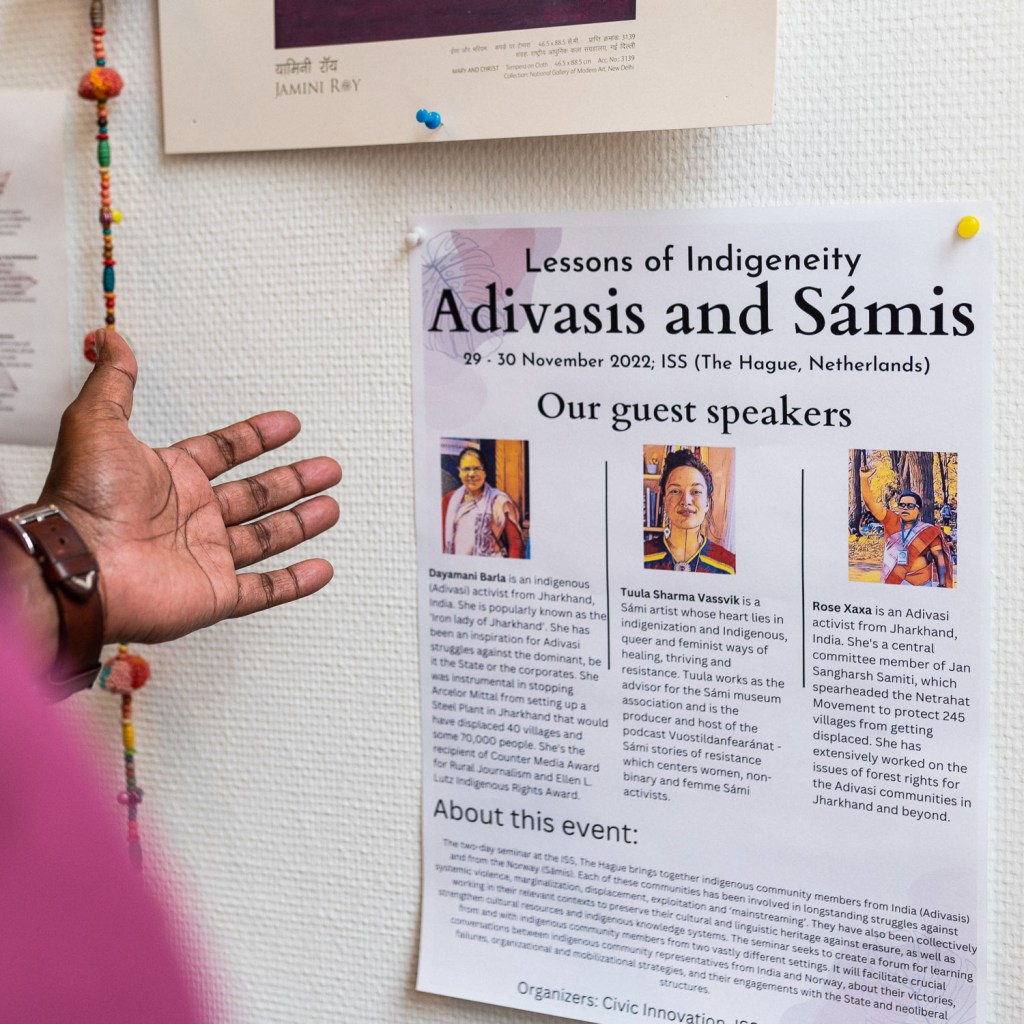
I have been thinking about this question. Not just for a few days but since we first met at the conference we had, Lessons of Indigeneity: Adivasis and Sámis at ISS university last yearIt is quite a provoking question: What is my Adivasi dream? For me it comes down to not having to fight or struggle. It sounds a bit abstract, let me put it in context.
My dream is to live the day when my people do not have to relentlessly struggle against all the marginalization and oppression that they are going through on a daily basis. I feel guilty that I am comfortably working here. Of course the idea is to finish this PhD and as soon as possible go back and pool in as many resources as I can to help my people. The point being is I cannot personally opt for doing something without taking into consideration the pains and troubles that my people are going through. It is constantly there hovering over your shoulder and it is not just about feeling guilty, it is a responsibility that everyone carries to be there for the other person. When I look at other communities and their kids, when they reach a certain age they think of who they want to be, some might think of pursuing astronomy, movie production (not that we should do that too). But at that very age when students might want to explore options, what our Adivasi kids have been doing is fighting on the streets for their rights. When I was in high school, as I had moved to the capital city in Jharkhand, I had my first interactions with these struggles. And almost like every other day, at least two days a week, students would be out in the street against their ongoing exploitation and oppression. These struggles tend to be very long run. The type of conversations, then, we tended to have were always about: How do we fight? How do we get our demands so that people are not displaced from their homes, that people are not thrown out? I wish our rights were no longer distant dreams.
How do you understand sovereignty different from western state Westfalia idea of sovereignty?
I see sovereignty as a very complicated space or discussion, where basically sovereignty does not exist for Adivasi communities. Let me talk about Adivasi in urban spaces and then of Adivasi in rural spaces. In an urban space I can bring my own example. I do not know my mother tongue, I am not fluent. Why I don’t know my language has to do with how I was raised, which is related to my parents’ life experiences. My mother once told me that when she had moved with my dad to a particular working place, there were a whole lot of people who had come together just to see her because they had never seen an Indigenous person. They wanted to see: How does an Indigenous person look like? That can be a very humiliating experience. You can internalize it as: I have to be more normal. So I always had my parents telling me: Be fluent in English, be fluent in Hindi. These are the languages of the normal and of the mainstream. These are the tools to fight and navigate the system. And I get their point. But it is also the point that in an urban space because of the hegemony of mainstream non-adivasi communities, there is so much marginalization, so much violence at the cultural and epistemic level that we start hating our own skin. Literally start hating our own skin wondering: why am I of this shade? Why can’t I look like others? Somebody says one derogatory word and we are put back in our place and we think: Maybe they are right. Why is my hair like this? We start self-harming or putting ourselves in an inferior position. We want to be like our peers. I am not putting blame on any of my peers. I don’t say that they deliberately become part of such marginalization processes. It is what the larger structures make them do, and they and I exist in that structure as well. I often wonder how do I navigate? When it comes to sovereignty in urban spaces we never have that space to be open about ourselves or be free. Now with all the social capital and all the resources I have here, I think I can be myself, maybe. But even now, I have to navigate my way if I want to find resources to work with and for my community. But to practice sovereignty at an early age in an urban space dominated by non-adivasis, I really don’t see that happening.
Let’s talk about rural spaces. This is where the tricky part comes in. In rural spaces aswell the state or non-adivasi communities try to dominate. Let me give you a brief example of what I am working on now. There are these eight villages in a very deeply forested area in Jharkhand. It is a place that I work with and where I consider my home to be. They are in an area marked for a tiger-project the government has come up with. Here they want to have a human-free habitat for tigers. So when the government came up with the project they tried to push people out of this area. More recently since 2017 the state has been really pushing hard: ‘You people have to displace!’ There are two villages who at some time gave in to getting relocated. The forest department did not let any development workshappen in these areas. You have to remember they are deeply inside the forest. To reach there is very very difficult. There are no pathways. There are entirely muddy roads, you have elephants roaming around. You can be crushed by them, anything can happen. The last time I was there, a person from the village had just been crushed by an elephant. The point being; the forest department has deliberately not provided any facilities in these areas. Nothing whatsoever. This was one of the primary reasons for the two villages to give in their consent. And then, there had been incentives: if you consent we will provide you these things. So finally two of the villages accepted. And now when the relocation time has come, the forest department says: ‘Well, we don’t really have a space for you to relocate. Maybe we’ll just give you some money and you can just push out.’ The money is so meager that nothing can happen from that. So even in the deep forest areas, Adivasis are not sovereign. Adivasis do not have the right to be themselves, to have their own family set up, their own cultural set up, their own governance set up where they can be just themselves. There is always a hovering entity that comes and tries to take away their rights. I think of sovereignty as something that is very bitterly fought for. It is not something we currently possess.
Hence the struggle. But what is the freedom we are fighting for? What could Indigenous sovereignty look like?
Frankly speaking, I don’t know. The struggle has been so long… I really don’t know. I am imagining it would be a place where Adivasi children wouldn’t have to worry about: Oh that person is speaking a better language. Where they don’t have to worry about the color of their skin. They don’t have to worry about anyone passing by and making sneering remarks on them. I imagine an alternate version of me in sovereignty. I would grow up learning my language, and knowing my culture, not being laughed at when speaking it. They actually laugh at it. There is a very wrong portrayal of us in movies, which have done so much harm. Adivasis are shown as dancing around wearing certain things and literally saying ‘Jingalala’ gibberish. What does that even mean? Making weird noises. The fact that they portray us in a derogatory way as something that has to be laughed at makes me crawl within my own skin.
What could be a babystep for you personally?
For me it is always about giving everything, whatever is there, for the community, for the mobilization to fight back. People have to come together and fight this through. But when I say that I also realize the differences that have been created through colonial practices. Like I was saying about christian missionaries; we have christian people who are economically well off. Then there are Sarna Adivasis (animist) who tend not to have that much resources. And then it becomes really important for the community itself to come together. For me, then, it is about asking: How do I engage in mobilization processes? Coming together in community is for me also recognizing my own colonial baggage and then embracing the Sarna identity as well for myself. I see that as a very important point. Secondly it is about fighting systemic oppression that happens at a larger level. This requires resources. It really requires many many resources: proper solid financial resources.
Photography: Mia Tengco
Artistic Director/Editor: Chihiro Geuzebroek
 INDIGENOUS DREAMS
Leave a comment