Can you Introduce yourself?
My name is Ayesha, I am a proud Yirrganydji woman of the Djabugay nation. Our traditional lands are from Cairns city, along the Great Barrier Reef up to Port Douglas in Australia. We are Seawater people and our totem animal is the Yirrigandji (a jelly fish).
Our nation territory also includes the Daintree rainforest up to the Yarrabah Mission. Wee are connected through the Yidiny and Djabugay language language aswell as share in similar yet distinct cultural practices and knowledge. I came to the Netherlands six years ago for work. I am a Business Operations Expert and was working in the fashion industry but since coming here I have really been inspired by how much more there is to life than attaching yourself to a brand. I started to move more into sustainability around four years ago. Since then I have been working for different Global sustainability organizations and Indigenous Not-for-Profits in Australia. I am also on the Board for Black Pride Netherlands, an organization which focuses on creating safe spaces for BIPOC Queer protests, healing, awareness and celebration.Indigenous people weren’t included in the Australian census as people until 1967, the last referendum about Indigenous Australians. At that point my father would have been six years old. There is a common term that frames us that we were nothing more then flora or fauna, meaning we were not people, we were animals. In the same sense that we are not acknowledged in the Netherlands, as being individual groups.
Though I have found myself more coming into being an Indigenous person outside of Australia. Kind of coming full circle: Having to go the furthest away possible to come back to oneself. For Indigenous Australians we call this ‘Walkabout’.
Where do you dream?
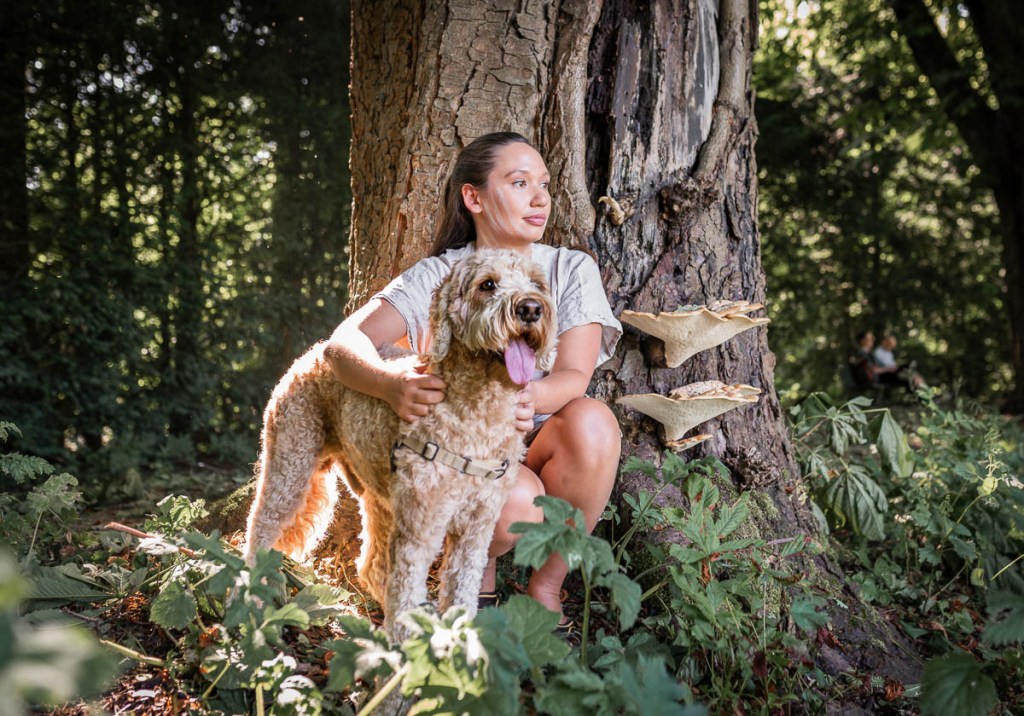
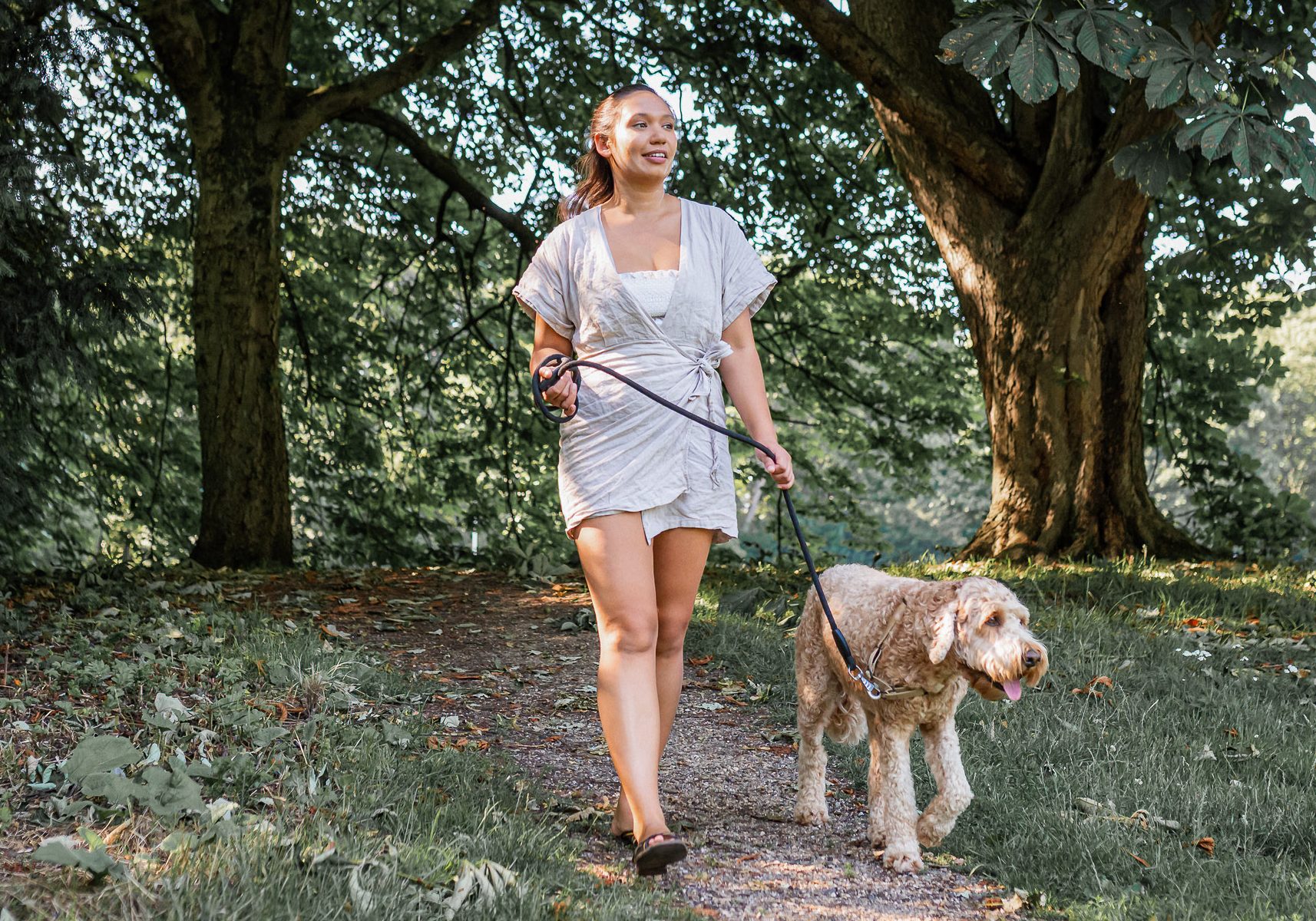
I come to the Amsterdamse Bos to do my daily dreaming. Right now it is july seventh an important time of the year. It’s NAIDOC week, which is our cultural week where we celebrate Indigenous culture and Also campaign for Indigenous rights. I love coming here because it feels like home. You are walking here and though the flora and fauna might not look like home, the feeling of home lives in the earth, lives in the trees and the smell of the forest and you are to transform through time and space. Being here reminds me of home. My dream buddy is Moby, my Australian labradoodle. He is very much part of my dreaming process. He also makes me feel safe and at home. Even if we don’t speak the same language, we are the same. Our friendship is an unbreakable bond. He can come here and be off leash which is really nice that we can both be free.
What is your Indigenous dream to wake from colonial nightmare?
As Indigenous people, who we are and what we dream of is always incorporating our cultural identity; so our personal and political dreams are very intertwined. A personal dream for me is being able to be confident, proud and stand tall in my Indigeneity no matter where I am in the world. When I was young in Australia I definitely did not feel that. And now it is growing everydayt is a dream that is unfolding all the time. I am meeting other Indigenous diaspora and meeting people outside of Australia who are genuinely interested and concerned about what is going on at home. Whereas people at home I mostly meet people do not care.. I grew up in a very white surfy coastal town far, far awayfrom my traditional lands and people. I didn’t grow up around Indigenous people. No one ever talked about Indigenous culture, they never asked about it, nor did my friends. They didn’t want to know. That continued well up to when I left Australia. My parents also didn’t talk much about it as they are conservative christians.
Part of the White assimilation policies or indoctrination of Indigenous culture into white society was by enforcing christianity. So it is a common theme in my family that we have to deal with these two sides of ourselves. You grew up in Christian culture, but christian culture took everything away from us.
It was the vehicle for dispossession.
Yes. So from the political standpoint, that is also intertwined with personal dreaming, is that my people can know peace. Which I believe can only come through treaty. This year is a very important year for Australia. It is the first referendum of my lifetime about Indigenous Australian’s called The Voice to Parliament. It all began through the formation of the Uluru Statement of the Heart. In 2017 250 Elders and delegatesfrom around the nation came together and signed a document saying that these are our wishes, a collective vision for our people. There are three pillars to that. One is the referendum vote; yes or no voice to parliament. This is not an overriding vote, it is basically a group of Elders who advise the government on Indigenous rights.
In no way whatsoever is this a swing vote. It is just having people there to speak on behalf of Indigenous people. This can also be in solidarity with other Indigenous people. Australia has such powerful geopolitical positioning and has done a lot of damage to Indigenous groups around the world. They are interconnected with the situation in West Papua. So if we have Indigenous people and a voice we can speak for and with Indigenous peoples. Think of climate change; we together as Indigenous peoples…
want to stop being the sacrifice zone.
Exactly. When we Indigenous people do 80% of the protection.
And they do over 95% of the mining.
Exactly. The other two pillars are Right to Truth Telling, similar to what has happened in Canada. They have had truth telling ceremonies. It was over six years, there were aroundsix thousand people interviewed and a lot of classified documents were released so that the real story can be told. Which opens the government up, the crown and also individuals who have benefited from colonization through generational wealth. It opens people up to risk. But it isn’t something new. Brothers and sisters from around the world have access to a pillar like this. We want to do it too. The third pillar is the Makarrata meaning ” a process of conflict resolution, peacemaking and justice” ; in other words a Treaty for peace between the Crown and Indigenous peoples in Australia.
Would that be upholding historical treaty or new treaty?
It would be a new treaty. We don’t have a treaty. We are the only commonwealth country in the world that doesn’t have a treaty with the crown. There was no treaty established in 1770 and the legal term Terra Nullius meaning ‘the land belonging to no-one’ was not thrown until 1992, the year I was born.
In some countries, like in Canada, there are certain tribes that entered into treaty where as others did not. And there has never been a surrender or a treaty; it is unceded territory. So you don’t have any treaty! How many Indigenous peoples, nations or tribes does Australia have?
There are over 260 clan groups . And unfortunately many are dying populations or have completely been destroyed. So there could have been many more. And this is the thing with oral story truth telling… From a white perspective it is not classified as evidence. So through this pillar of truth telling hopefully the oral history can be recognized.. To establish voices for people that have been lost. I am a big believer in the Uluru statement of the heart. It is the first time we have all come together and consecutively had an all encompassing process together as one. Which in a country the size of Australia is hard to do. Especially with our Elders being so old and still suffering from the effects of the stolen generation. This was the Australian version of Residential schools. The Government would take Children from their families, and place them in the care of The Church or they were adopted into white families all over Australia.
With colonization they play the game of ‘divide and conquer’ aswell as govern with differentiated oppression.
Exactly. We see that a lot with land rights. In theory it is a good thing but the way it is practiced it is dividing us. Because it is situated in people owning land. But traditionally the land always owns us. So it is outside our frame of culture. We are then brought into a white system where we have to figure out how we can interact and exist within it together that means putting on a white mask. I do need to add that at home with the referendum there is a divide between Indigenous people. For some people feel that having a voice to parliament, is us coming further into the white system. We have been trying to avoid that for a very long time. Some fear that with a voice to parliament sets us back from getting a treaty or is not necessary for us to get a treaty.
What does sovereignty mean to you in light of your Indigenous culture and experience?
In Australia, sovereignty is the Crown and its political ownership and absolute power of the Australian people. This sovereignty is ownership of everything – body, land, housing, food, water. From my Indigenous perspective, the Earth, Water, Sun and Sky are our Sovereigns. Again coming back to this idea of ownership that is not endorsed by our culture. It is very much that the Earth or the water owns us. Not the other way around. Sovereignty connotes Hierarchy, power, Elitism, perhaps a new word needs to be established to capture the Indigenous meaning. For me, self determination is an individual act of Sovereignty. The right to Self determination really means having the freedom of choice to live, dress, eat, however or wherever you want. Whether that means you stay in Australia in the bush than that is your self determination. Or if it is for me to be here in The Netherlands, that is my self-determination. This referendum is a stepping stone towards sovereignty and self determination for me and my people. If it is a no vote, then I fear we may miss the opportunity of my lifetime.
My dream is for me to learn the Yidiny language and continue on our oral history and traditional culture. I hope to be part of designing and leading the program that maps and digitizes the language so that it is accessible for younger generations and will give Yirrigandji and Djabuguy people who live all over the world the opportunity to connect back to culture. A program like this could mean that we could have local Indigenous languages taught in local schools.
We have to decolonize our mind to imagine what it could even be like to dream in that realm of Indigenous Liberation. It is not going to be of materialistic nature that white Dutch people often dream of. It is not going to be of monetary value or growth. It is going to be through things such as peace-making and babysteps like learning language and recognition of our ancestors who have passed on. Recognition of these events that have happened. It always includes the discussion of sovereignty and self determination and includes us as a people – not individualistic. So I guess we need more understanding that dreaming is so much more. My people have a lot of barriers to overcome, generational trauma that needs to be healed, more referendums to be won, but we are the longest living culture in the world. For over 60,000 years we have survived and pre-colonization we thrived together in solidarity with our global Indigenous Brothers and Sisters. I see where we have come and what we have overcome. I see where we are now and it makes me hopeful for the future. We are now not only surviving but we are beginning to thrive again.
What do you see as needs for that place to run in a good way?
The co-design process would have to include an opt-in process, for Indigenous people from the community to design it together. This could be a great way to initiate data collection around how many Indigenous Identifying people are also living in the Netherlands and what are their occupations as this data is unknown.
From this co-design process, procurement policies could be established around who would be a vendor/or be employed by the center. A sustainability calculation model could then be established for how much economic and social value could be generated which would indeed help for getting funding from local, national and international funding bodies. For it to run efficiently and fairly, it would need to have a board of Elders nominated from the opt-in group, and Indigenous only people working in the front and back-end operations. Really highlighting by Indigenous, for Indigenous. This idea is a first of its kind as far as I’m aware. I LOVE IT.
Okay let me take my Operational expert hat off for a moment and dream – I would love to see a center that is a safe space for people to meet and practice their culture and healing (meeting rooms, dance space), an exhibition space to showcase thriving Indigenous entrepreneurs and artists, a rotating space which highlights a topic and how different Indigenous diaspora interpret it here and in their local communities, and a truth telling space where we can rewrite history with OUR STORIES.
Photography: Mia Tengco
Artistic director/Editor: Chihiro Geuzebroek
 INDIGENOUS DREAMS
Leave a comment